Ethan’s psychopathic traits
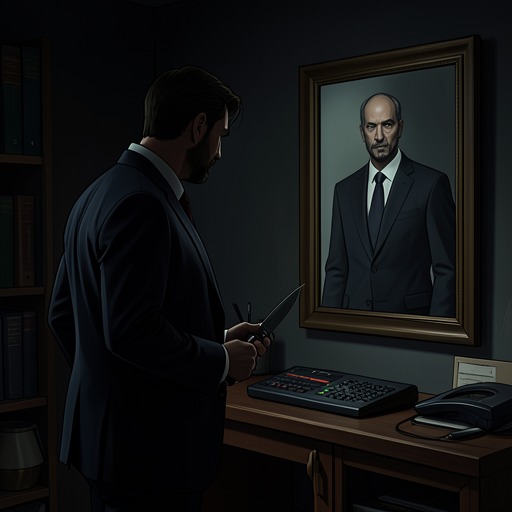
The Woman in the WindowEthan’s psychopathic traits become explicit in a confrontation with Anna in which he names what he is, then demonstrates it through a series of admissions. His account joins superficial charm and emotional performance to deliberate manipulation, covert surveillance, and a casual confession to violence. The scene’s force lies in the gap between the soothing manner he can adopt and the threat of the letter opener in his hand.
Identity and self-description
Ethan tells Anna, “I know what I am,” and asks whether knowing helps. The narration identifies the traits under discussion as superficial charm, a labile personality, and flat affect, while the letter opener makes the danger present rather than abstract. Anna guesses that he grew up hurting animals; he confirms it, describing how he gave her cat a rat he had cut up after finding it in the basement. He dismisses the act as easy and calls the city disgusting. His response treats cruelty not as a source of shame but as an occasion to challenge Anna to identify what else he has done.
That exchange establishes an unsettling division between recognition and remorse. Ethan can acknowledge the behavior Anna names, but acknowledgement does not make him safer or more accountable. He presents his traits as something Anna might diagnose while he remains in control of the conversation, holding the blade and inviting her to keep guessing. His calm, almost soothing self-description therefore works alongside intimidation: the language of self-knowledge does not soften the physical threat.
Manipulation as performance
When Anna says he enjoys manipulating people, Ethan agrees that it is fun and easy, and tells her she is particularly easy to manipulate. He winks. The gesture turns his confession into another performance, using apparent playfulness to sharpen the insult and to show that he knows how she has been responding to him.
He then explains how he shaped that response. After coming on too strongly with Jennifer, he says, he decided to move more slowly with Anna. He had claimed to miss his friends, pretended he might be gay, and cried repeatedly so that she would feel sorry for him and regard him as harmless. He also admits that he cannot get enough of her. The disclosure connects calculated tactics to an obsessive interest: his cultivated vulnerability was a means of gaining sympathy, while his fixation made the resulting access gratifying in itself.
Ethan describes even his visible behavior as something staged for Anna. He asks whether she noticed him undressing in front of the window on a couple of occasions and says he knows she saw him once. The admission reverses the apparent direction of looking: Anna had been watching her neighbors, but Ethan had deliberately made himself part of what she watched. His performance of exposure was another way to manage her attention and to make her surveillance serve his purposes.
Surveillance and control
Ethan says he had been coming into Anna’s house at night for a couple of weeks, walking around and watching her. He describes the quiet, dark house as interesting and compares his attention to conducting research for a documentary. He also says he used Anna’s phone to take a picture of her. His language makes intrusion sound like detached observation, but the circumstances—repeated nighttime entry and an image taken without her knowledge—show how completely he has crossed the boundary between watching and invading.
The scene supplies further details of that control. Ethan says he removed the batteries from the device in the library, leaving Anna without the protection or evidence she might have expected from it. He boasts that he unlocked her phone, though the account here does not explain how. The phone, which has slid down the bed beside Anna’s elbow, becomes an object she focuses on while he speaks; he later explains that he used it to photograph her. His boast about access converts a familiar personal device into proof that the privacy she thought it offered had already been breached.
He also reveals that he created a Gmail account on Anna’s own computer and sent the photograph to her email. He chose his mother’s name for the account and drew on what Anna had told Lizzie: that her family used to say “guess who” when they spoke. Repeating the phrase as a taunt, he exposes how he turned private information shared in a support conversation into a tool for frightening her. The photograph, the false account, and the borrowed family phrase form a calculated message: Ethan has been inside Anna’s home, has learned what matters to her, and can make that knowledge appear to come from elsewhere.
Violence and relationships
Ethan’s account of Katie’s murder makes his violence part of the same pattern of control. He recalls that Anna became frightened about Katie and calls her reaction insane, then says he did it in front of his father, Alistair Russell, who also panicked. Ethan speculates that Alistair was relieved Katie was gone because she had angered him. He adds that he should have checked the windows, but the event happened too quickly, and that denying it was easier than lying or telling the truth. In the same breath, he expresses some sympathy for Alistair, who, Ethan says, only wanted to protect him.
That account reveals both the killing and the family conflict around it, but Ethan narrates them without taking responsibility in a conventional sense. He calls Katie irritating, treats his father’s reaction as evidence to interpret, and describes concealment as a practical choice. His statement that he feels bad for Alistair sits beside his admission that Alistair tried to protect him from Anna, even though he knew what had happened. The combination exposes a relationship in which protection and knowledge coexist with the concealment of Ethan’s violence.
For Anna, the confrontation turns the earlier signs of friendliness and vulnerability into evidence of deliberate deception. Ethan’s comments explain why he performed distress, how he watched her, and how he used what she had disclosed to Lizzie. They also show that his attention was not limited to observation: he entered her home, disabled a device, accessed her phone, and admitted to killing Katie while holding a letter opener. The traits named in the scene are thus conveyed not as a detached diagnosis but through the concrete methods by which Ethan makes other people’s trust, fear, and privacy available to him.